ESSAY • March 2024 • Sensitive Content Magazine
I am no stranger to being watched by strangers.
You could say I’ve been a reluctant exhibitionist since I was nine years old. Hours and hours of my young life were spent sitting in the soundproofed chambers of audiometry labs being studied and stared at by audiologists, pathologists, and their students, all shadows on the far side of a dim window. I performed for them as best I could, danced through their pure tone tests with hand waves and salutes, amused them with lucky guesses to unintelligible questions they choked through interphones, and dutifully recited words and phrases from lists while they probed my ear canals with scopes and contemplated my speech, the shape of my mouth, and the strength of my tongue.
The eyes followed me home and into school. My large amber-colored hearing aids and clunky telecoil receiver clipped to my belt invited glares, then interrogations, prying fingers, and fists. I started refusing to cut my hair, let it grow long over my eyes and ears and down my neck as a shield. I drowned myself in sweaters to conceal my assistive devices and body, withdrew from athletics, from gym class, avoided locker rooms and swimming pools. I stopped using sign language for a while, turned interpreters away so they wouldn’t redirect the attention of a room full of people back onto me.
Being deaf at a young age induced observation — relentless surveillance — and the co-occurrence of growing up gay in an unkind and unsafe community meant that I lost years of my life trying to hide myself.
Obviously, that changed, since this is accompanied by examples of the exhibitionist avocation I’ve assumed. I never thought I would publish nude photos of myself online, for both the aforementioned experiences of my life and other pursuits that are admittedly more important to me, like my work as a writer and my public deaf and disability advocacy. Nonetheless, a couple years ago, I took a chance to be seen — the flash point of a slow accumulation of self-acceptance, self-knowledge, and nerve.
There’s no question that the experience of a gay man revealing himself to an expectant, sex-positive, queer audience is gratifying, even luxurious sometimes. I imagine many people assume the motive is simple hedonism. The opportunity to arouse and inspire worship from other men is exhilarating, but I have since learned that there’s a more profound payoff.
Exhibitionism has become a ritual of recovery of my body, an exercise in self-determination and resistance. I choose what you see of me every time, in every photo. It’s my decision to capture my face at any of its angles, to wear a grin or glower, jockstrap or jewelry, show a glimpse of my armpit, belly, or ass, or reveal the head of my cock. Even my tattoos signify reclamation, every one a treasure of choice. When you observe me now, you are given only what I have purposefully made of my image, my body, in all of its audacity, potency, and appeal.
Queer exhibitionism isn’t just expression, either. It’s connection. It invokes dialogue, call and response. For me, it is the call of a queer person to other queer people to bear witness, to see and be seen by one another. It’s a consummation of years of longing to be noticed and wanted, not just watched, monitored, or menaced. Hope for a gaze becoming reverence, even desire.
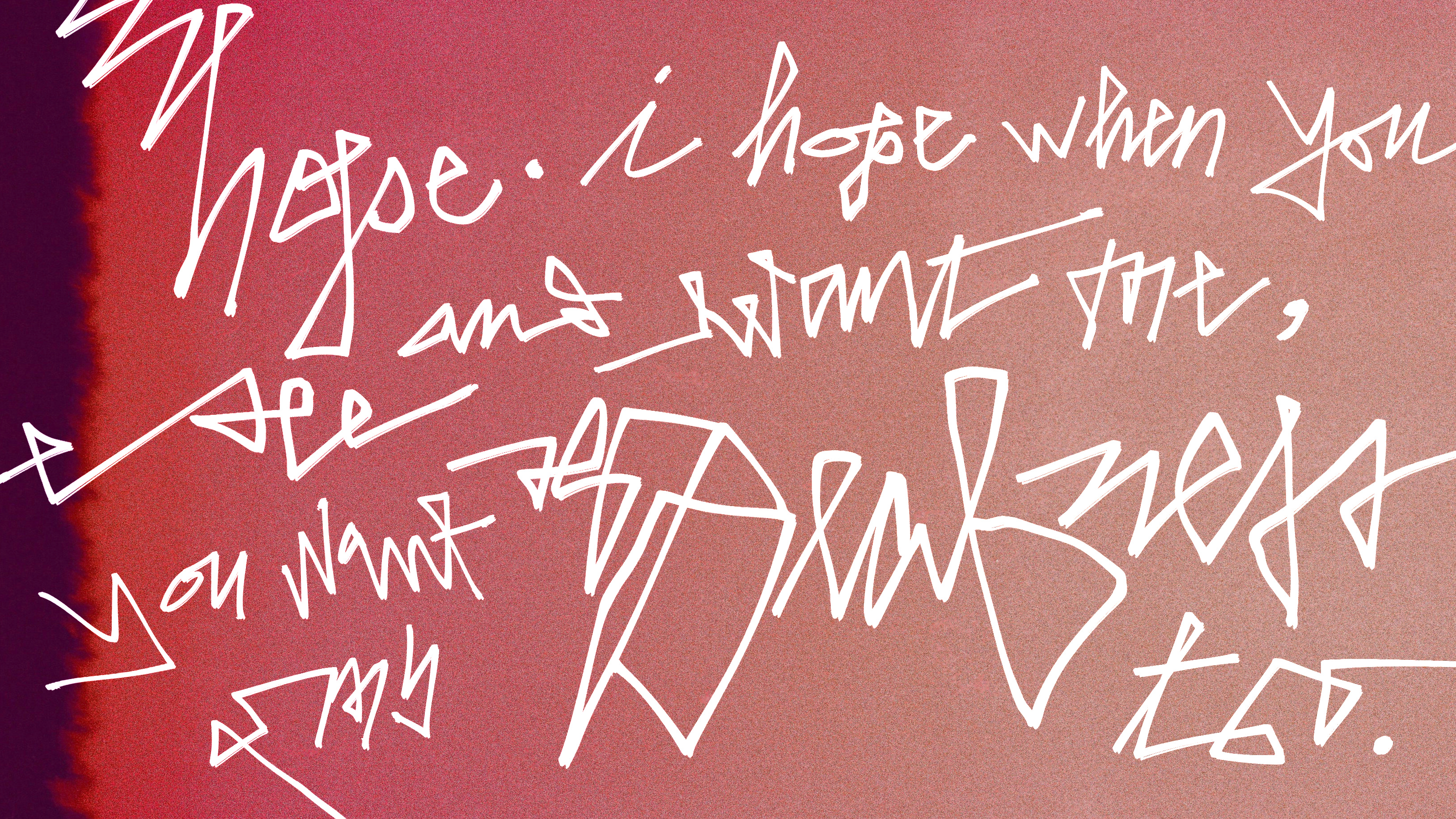
And that’s what this is really about: hope.
I hope, when you see and want me, you want my deafness, too.
I am deaf and disabled. I don’t discard my deafness like socks, boxer shorts, or a robe as I undress. When you imagine me in bed, your tongue racing up my throat to my chin, my nipple hardening beneath your thumb, our bellies bowing against each other, our lumbering cocks between us, am I still deaf? Does your fantasy account for the impossibility of lipreading in a lightless room? The ease with which my hearing aids are jostled or crushed by a drifting hand, shoulder, or thigh? Which ear of mine will receive your lewd instructions best or if I’ll hear you call me daddy, boy, or babe at all?
Does our romance ever reference my odd, uncertain voice and stutter, the dwindling strength and ability of my hands, or my fragile, injury-prone joints? Do you ever think about signing with me? Consider how you might sign fuck me, suck my dick, or did you cum? Wonder how sign language negotiates sexual intimacy? How it survives the collapse of space between two bodies in darkness?
On a screen, on a page, it’s easy to gloss over my disability when it isn’t always apparent in the images of me that delight you, when you see a one-dimensional man who may be subjected to your interest without issue. Our parasocial encounters coincidentally bypass most or all of the communication barriers I endure, too. My deafness proves forgettable when it doesn’t require your attention. As my photos circulate among admirers, my inboxes teem with filmed and voice-recorded messages, requests for video calls, and invitations to meet in-person, all bearing a stinging, subliminal assumption that I’m a hearing person.
Perhaps worse are the times when my disability isn’t ignored, when correspondence becomes clinical as my deafness emerges. Erotic urgency dissolves into antiseptic questions about my impairment, about the technical differences between cochlear implants and hearing aids, awkward apologies about not knowing sign language, half-promises to learn it, and requests for me to teach it. Occasions of overt ableism are uncommon, but unavoidable, like offers of sympathy for my special needs, accusations of not seeming retarded enough to be disabled, and responses of cruelty and abuse that don’t deserve elaboration.
These interactions may not share intent, but they intersect upon the same conclusion: you don’t want me to be deaf. You want me as I appear in photos, as a man flung out of space, without personal constraints, no past or purpose other than to be an instrument of indulgence. But you cannot bisect me into halves, keep the one you like and return the other to the dark rooms of labs to be examined like an injury, condemn it to remain a boy sealed in soundless booths who is only ever seen to be fixed or broken.
When you refuse my deafness, you refuse me.
For so many of you, disability numbs all erotic ambition — even with me, whose disability is comparatively uncomplicated, who has no disfigurements or artificial limbs, requires no mobility aids or extensive medical supports, and who is white, thin, masculine, and cisgender. I still wonder if I would have had the opportunity to write this if it weren’t for the privileges I exploited to get here.
A social-cultural schism exists between disability and desirability, reinforced by an enduring mass exhibition of alienation and brutality, seen in generations of disabled people restrained like animals, confined to hidden rooms, hospitals, and institutions as permanent children and pariahs, deemed half-dead since birth, deprived of dignity of risk and choice, and starved of ownership of our bodies. How could we ever be understood as complex creatures of pleasure and emotion while trapped in the grotesque lives that were chosen for us? The desexualization of disability is both a casualty and deliberate construct of our progressive dehumanization, and you have unconsciously accepted it. Until now. You have to break the cycle.
Stop the show. Desist. You must.
Learning to love disability demands liberation. It requires us to rethink our love of the human body completely and challenge our sexual imaginations to favor what is imperfect, honest, and true about each other. It urges us to embrace the non-normative and the extraordinary, to wholeheartedly embody queerness. What if you allowed yourself to accept the allure of an unusual, asymmetrical face or a contentedly sightless eye? Gave yourself permission to see beauty in the shape of a buckled limb, the curvature of a crippled spine, or the coloration of a scar? What if you chose to welcome the possibilities of passion communicated silently, imprinted upon your bare chest and thighs in tactile sign by adoring hands?
I am continuously drawn to the promise of desiring disability beyond objectification, of being appraised in our sincerest entirety, where our impairments aren’t politely and fearfully ignored, but accentuate, inform, and inspire attraction and reverence as they appear. I hope for this and more. I hope for a renewed age of disability justice, for radical crip-queer communities of care and connection, for a future of disabled joy. I hope for the coming of a world where a deaf boy doesn’t have to take off his clothes to feel wanted, or maybe just one in which he knows from the very beginning that there is no need for him to hide.